
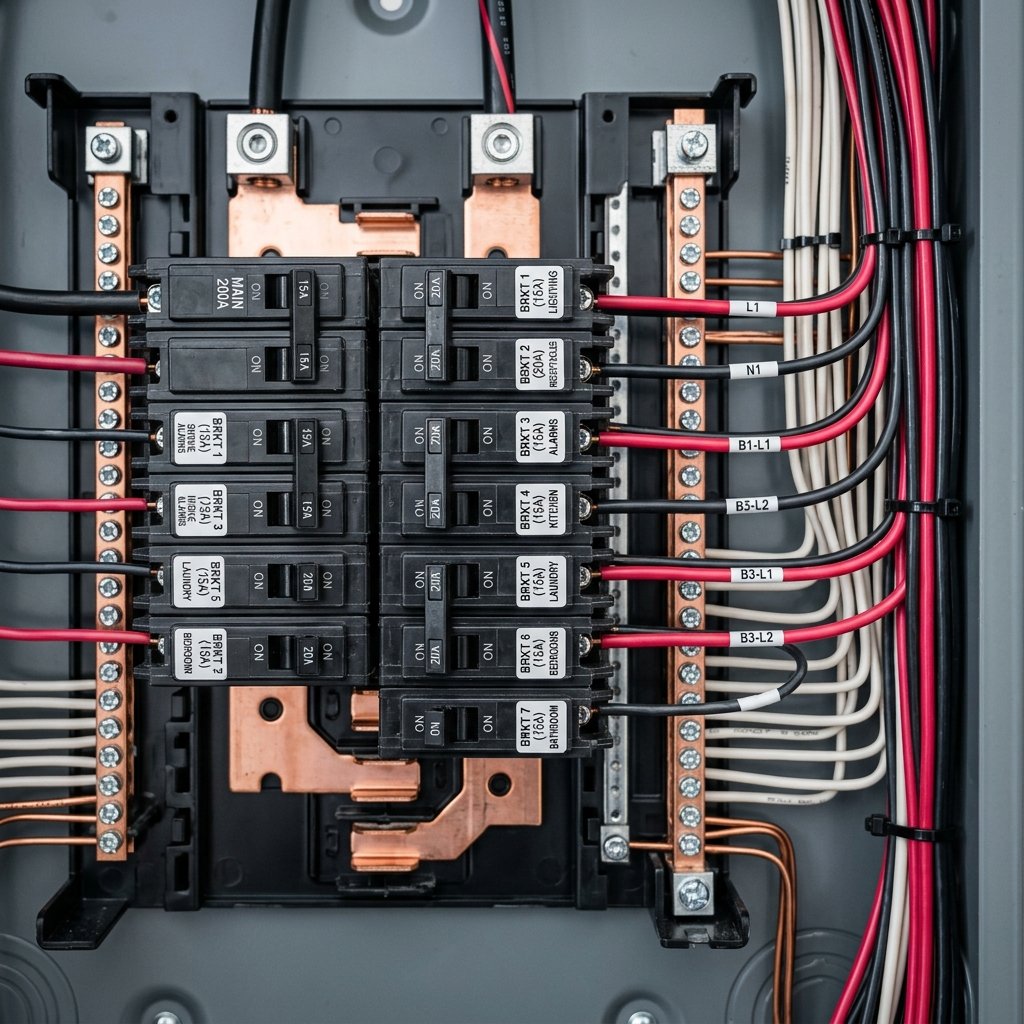
Is a Buzzing Electrical Panel Dangerous?
A buzzing electrical panel is often a critical fire hazard that requires immediate professional evaluation. While a very faint, smooth hum audible only when your ear is inches from the panel is normal 60Hz electromagnetic vibration, any loud buzzing, sizzling, crackling, or clicking sound indicates dangerous electrical arcing (electricity jumping loose connections), a corroded breaker-to-busbar connection, or a severely overloaded circuit breaker that is mechanically failing to trip. Left unaddressed, electrical arcing reaches temperatures exceeding 3,000°F and causes structural electrical fires.
- Faint hum vs. loud buzz: Low-volume 60Hz humming is normal magnetic vibration; loud buzzing, crackling, or frying sounds indicate active arcing.
- Loose busbar clips are the #1 culprit: Breakers loose on the panel busbar spark continuously, generating destructive heat.
- Failed trip mechanisms: A breaker carrying 120% to 150% overload that fails to trip will vibrate and buzz loudly right before failure.
- Never remove the dead-front cover: Exposed 240V utility lugs carry lethal fault current; diagnostic testing requires an electrician.
- Check for burning smells: Buzzing accompanied by acrid, fishy, or burned plastic odors indicates melting insulation and requires emergency service.
Normal 60Hz Hum vs. Dangerous Arcing
To determine whether your electrical panel’s sound represents normal operation or a dangerous fault, listen closely to its acoustic characteristics:
The Harmless 60Hz AC Hum
A normal electrical panel hum is a very low-frequency, smooth, consistent tone. It is typically only noticeable when you stand within 1 to 2 feet of the panel with the metal door open, particularly when large continuous loads like an electric oven or central air conditioner are operating. The sound does not stutter, pop, or change tone abruptly.
The Dangerous Electrical Buzz or Sizzle
Dangerous noises are much louder, irregular, and raspy. Homeowners frequently describe them as sounding like frying bacon, crackling paper, an insect trapped in the wall, or sharp clicking. This noise is caused by electrical arcing—electricity ionizing the air and jumping across microscopic gaps between loose or corroded metal surfaces.
Electrical arcing generates temperatures between 3,000°F and 10,000°F. At these extreme temperatures, copper conductors vaporize and surrounding combustible materials can ignite within seconds. If you hear sizzle or smell smoke, shut down non-essential power and call an electrician immediately.
The 4 Primary Causes of Electrical Panel Buzzing
When a licensed electrician removes the dead-front panel cover to inspect a buzzing breaker box, the issue almost always stems from one of four electrical failures:
1. Loose Wire Terminal Connections
Electrical wiring expands slightly under heating loads and contracts when cooled. Over years of thermal cycling, terminal screw lugs holding copper branch wires into circuit breakers or neutral busbars can loosen. A loose connection forces electrical current through a high-resistance point, creating micro-arcing and rapid buzzing.
2. Failing Breaker-to-Busbar Clips
Each circuit breaker connects to the panel’s main energized busbar using a tension-spring metal clip (stabs). If a breaker is improperly seated, or if repeated thermal expansion has weakened the clip’s tension, the breaker vibrates against the busbar. This vibration produces pitting, carbon soot buildup, and intense buzzing.
3. Circuit Overload Failing to Trip (Stuck Breaker)
When a circuit is pushed beyond its rated capacity (for instance, drawing 24 amps on a 20-amp breaker), the internal bimetallic strip bends under intense thermal stress. If the breaker’s internal mechanical spring is jammed, corroded, or seized, the breaker will buzz violently as it tries and fails to trip, posing an imminent risk of melting.
4. Main Utility Feeder Lug Looseness
If the buzzing sound is deep, loud, and originates from the top or bottom of the panel where heavy service entrance cables enter, the main utility lugs connecting to Duke Energy or TECO lines may be loose. This requires urgent utility-coordinated re-torquing or lug replacement.
Zinsco panels buzz right before total failure: In Central Florida homes, older Zinsco panels feature aluminum busbars that corrode rapidly. Breakers buzz, melt, and weld themselves directly onto the busbar. If you have a buzzing Zinsco panel, replace it immediately with a modern 200A panel upgrade.
Sound vs. Danger Level Diagnostic Matrix
| Sound Characteristic | Volume / Distance | Hazard Level | Likely Root Cause | Immediate Action |
|---|---|---|---|---|
| Faint, smooth hum | Only audible < 1–2 ft away | Normal | 60Hz AC magnetic vibration in breaker coil | No action required; monitor periodically |
| Loud, continuous buzz | Audible across the room | Moderate / High | Overloaded circuit or loose breaker terminal | Unplug high-draw appliances; call electrician |
| Sizzling / frying sound | Distinct raspy crackling | Critical Hazard | Active electrical arcing at busbar connection | Turn off main breaker if safe; emergency service |
| Clicking / rapid snapping | Repetitive mechanical click | Critical Hazard | Breaker trip mechanism stuck or arcing ground fault | Shut off circuit breaker; call for repair |
| Buzzing + burning smell | Fishy / acrid plastic odor | Severe Emergency | Melting wire insulation or charred panel busbar | Evacuate if smoking; call 911 / emergency electrician |
Safe Next Steps for Homeowners
If your electrical panel is buzzing, take these safety measures to minimize fire risk before an electrician arrives:
- Do NOT Remove the Panel Cover: The dead-front metal cover prevents accidental contact with energized 240V utility lugs. Removing it without personal protective equipment (PPE) exposes you to arc-flash hazards.
- Turn Off High-Wattage Appliances: Immediately turn off the central air conditioner, electric dryer, oven, microwave, and EV charger. Removing electrical load often silences the buzz and prevents catastrophic overheating.
- Check for Heat with the Back of Your Hand: Gently touch the outside metal door of the panel with the back of your hand. If the metal feels noticeably warm or hot, turn off the main breaker if safe to do so.
- Call a Licensed Electrician: A buzzing breaker will not fix itself. Loose connections continue to oxidize and generate more resistance over time until an electrical fire occurs.
How Licensed Electricians Diagnose & Repair a Buzzing Panel
When Winter Haven Electrician arrives to investigate a buzzing panel, our licensed technicians perform a systematic diagnostic protocol:
- Thermal Infrared Imaging: We scan the entire panel with a digital infrared camera to pinpoint high-resistance hotspots without touching components.
- Torque Verification: Every breaker screw terminal and neutral bar lug is torqued to manufacturer-specified inch-pounds using calibrated insulated torque drivers per NEC Article 110.14(D).
- Busbar Inspection: We remove individual breakers to inspect the silver/copper busbar plating for signs of pitting, black carbonization, or melted stabs.
- Circuit Breaker Replacement: Defective or mechanically worn breakers are replaced with OEM factory-certified units.
- Complete Service Upgrade: If the panel busbars are burned or the panel is an obsolete brand (FPE/Zinsco), we execute a complete 200A electrical panel upgrade.
Frequently Asked Questions About Buzzing Panels
When a central air conditioner starts, its compressor motor draws a massive momentary inrush current (often 50A to 80A). This sudden current surge creates a brief electromagnetic buzz in the AC breaker. However, if the buzzing continues while the AC runs, the breaker terminals are loose or the breaker is failing.
NO! Absolutely never spray any aerosol, lubricant, or liquid into an electrical panel. WD-40 is highly flammable and conductive when atomized; spraying it into an energized panel can trigger a violent arc flash explosion and instant fire.
Not necessarily. If the buzz is caused by loose terminal arcing, standard breakers will not detect the fault unless it creates a dead ground short or draws excessive amperage. This is why electrical arcing is so dangerous—it can smolder and burn for weeks without tripping a conventional breaker.
If the issue is simply a loose terminal that needs re-torquing, a diagnostic service call typically costs $150 to $250. Replacing an individual defective circuit breaker usually ranges from $200 to $350. If the busbar is severely charred, replacing the panel costs $1,800 to $3,800.
Authoritative Sources & Further Reading
- National Electrical Code (NEC): Article 110.14(D) (Tightening Torque Requirements for Electrical Terminations).
- NFPA 70E: Standard for Electrical Safety in the Workplace (Arc-Flash and Electrical Arcing Hazards).
- Underwriters Laboratories (UL): UL 489 Standard for Molded-Case Circuit Breakers and Circuit-Breaker Enclosures.
- Electrical Safety Foundation International (ESFI): Detecting Warning Signs of Home Electrical Fires.