Why Does a Circuit Breaker Keep Tripping?
A circuit breaker repeatedly trips because the electrical demand on that circuit exceeds its rated amperage capacity (an overload), hot and neutral wires are making direct contact (a short circuit), electricity is leaking through water or damaged casing (a ground fault), an appliance motor is malfunctioning, or the breaker mechanism itself is degraded. Because a breaker is a deliberate safety valve designed to prevent structural electrical fires, repeatedly resetting it without isolating the underlying fault creates severe heat damage inside wall cavities.
- Breakers are emergency safety valves: Tripping is deliberate protection, not a malfunction. It halts electrical flow before wiring insulation melts.
- Never force a breaker to stay on: Forcing, taping, or repeatedly flipping a tripping breaker bypasses crucial fire protection.
- Timing offers clues: A breaker that trips after 10 minutes of appliance use is usually overloaded; a breaker that trips instantly with a loud pop indicates a short circuit.
- Florida summer heat contributes: Attic and garage breaker panels operating in high Central Florida ambient heat experience thermal derating, lowering trip thresholds.
- When to stop and call: Burning odors, charred outlet plates, buzzing panel noises, or instant re-tripping require immediate professional multimeter diagnosis.
- Quick Answer
- 1. How a Circuit Breaker Protects Your Home
- 2. 5 Common Causes of Repeated Breaker Trips
- 3. Comparison: Overload vs Short vs Ground Fault
- 4. Interactive 3D Electrical Panel Explainer
- 5. Central Florida Heat & Climate Strain
- 6. What Homeowners Can Check Safely
- 7. How an Electrician Diagnoses the Fault
- 8. When Should You Call an Electrician?
- 9. Frequently Asked Questions
- 10. Authoritative Sources & References
How a Circuit Breaker Actually Protects Your Home
Every home's electrical system is organized into branch circuits. Copper wiring of a specific gauge runs from your central electrical service panel to outlets, lighting fixtures, and dedicated equipment throughout the house. A standard 14-gauge wire is rated for a maximum of 15 amperes, while a 12-gauge wire is rated for 20 amperes.
If there were no protective device on the circuit, plugging in too many high-draw appliances would pull excessive electrical current through that wire. The resistance of the copper wire produces heat. As heat accumulates, the PVC insulation surrounding the wire melts, degrades, and can easily ignite wood wall studs, insulation, or drywall paper.
A modern standard breaker utilizing two internal mechanisms: a bimetallic strip that bends under slow heat accumulation (thermal overload protection) and an electromagnet that instantly trips during massive current spikes (magnetic short-circuit protection).
When a breaker trips, its internal spring moves the operating handle to a neutral, middle position (neither fully ON nor fully OFF). Understanding why this trip occurred is essential to maintaining your home's safety.
5 Common Causes of Repeated Circuit Breaker Trips
While all trips look identical from the front of the electrical panel, the underlying failure usually falls into one of five distinct electrical categories:
1. Overloaded Electrical Circuit (Most Common)
An overloaded circuit occurs when the total electrical demand of operating devices exceeds the circuit's rated continuous capacity. Under the National Electrical Code (NEC Article 210.19 & 210.20), branch circuits are designed to operate continuously at no more than 80% of their maximum rating (12 amps for a 15-amp breaker; 16 amps for a 20-amp breaker).
For example, in many older homes in Winter Haven, all kitchen countertop receptacles may share a single 15-amp branch circuit. Running a 1,200-watt microwave (10 amps) and a 1,000-watt toaster oven (8.3 amps) simultaneously draws 18.3 amps through a 15-amp wire. The bimetallic strip inside the breaker slowly heats up, bends, and triggers the trip mechanism to protect the wall wiring.
2. Short Circuit (Severe Hazard)
A short circuit is a dangerous fault condition where an energized "hot" wire comes into direct physical contact with a "neutral" wire or grounded metal junction box. Because there is virtually zero resistance across the connection, current draw spikes into hundreds or thousands of amperes in a fraction of a second.
The breaker's magnetic coil instantly disengages the circuit to prevent explosion and fire. Short circuits frequently stem from loose wire connections inside an outlet box, damaged appliance power cords, drywall screws piercing hidden Romex cables, or rodent damage to cable insulation in attics.
3. Ground Fault Condition
A ground fault occurs when an ungrounded hot conductor touches a bare copper grounding wire, a grounded metal box, or conductive moisture that creates an unintended path to earth.
Safety devices engineered to sense minute current imbalances between hot and neutral wires (as small as 4 to 6 milliamperes). If current leaks outside the circuit, power is cut within 25 milliseconds to prevent lethal electric shock.
4. Faulty or Defective Appliance
Sometimes the household wiring is completely intact, but an internal motor winding, compressor, or heating element inside an appliance has failed. Common culprits include aging refrigerators, space heaters, hair dryers, sump pumps, and dishwashers. If the breaker only trips when a specific piece of equipment is plugged in or cycles on, the appliance is likely experiencing an internal electrical fault.
5. Aging, Worn, or Mechanically Weak Breaker
Like any mechanical switch, circuit breakers contain springs, contact points, and bimetallic assemblies that wear out after decades of service and repeated trip cycles. An aging breaker can develop weakened internal calibration, tripping at normal operating currents (e.g. tripping under an 8-amp draw on a 15-amp breaker). In addition, older electrical panels such as Federal Pacific Electric (FPE) Stab-Lok or Zinsco panels are notorious for failure to trip or catastrophic internal arcing.
Never swap a 15-amp breaker for a 20-amp breaker to stop trips. A circuit breaker is sized to protect the thinnest conductor connected to it. Installing a 20-amp breaker on 14-gauge copper wire allows the wire inside your walls to reach combustible temperatures before the breaker trips, converting your concealed wiring into an unmonitored heating element.
Comparing Electrical Fault Types: Overload vs Short vs Ground Fault
Recognizing the specific characteristics of your electrical issue helps you describe the situation accurately to an electrician and determine whether immediate emergency shutdown is necessary:
| Fault Type | Trip Speed | Hazard Level | Typical Indicator | Recommended Action |
|---|---|---|---|---|
| Circuit Overload | 1 – 20 minutes | Moderate | Multiple appliances running together; breaker feels warm | Unplug high-wattage devices; redistribute loads across circuits |
| Short Circuit | Instant (milliseconds) | Severe / Fire Risk | Immediate trip upon flip; loud pop; black soot marks | Leave breaker OFF; inspect cord; call licensed electrician |
| Ground Fault | Instant (milliseconds) | Shock Hazard | Occurs in wet areas; GFCI button pops out; pump activates | Disconnect damp devices; test receptacle; inspect exterior boxes |
| Arc Fault (AFCI) | Fast (microsecond detection) | Fire Risk | Trips randomly; loose switch; cord pinched behind furniture | Check for damaged cords; have electrician test circuit integrity |
| Worn Breaker | Unpredictable | Equipment Wear | Trips under minimal load; breaker switch feels loose or spongy | Professional panel inspection & component replacement |
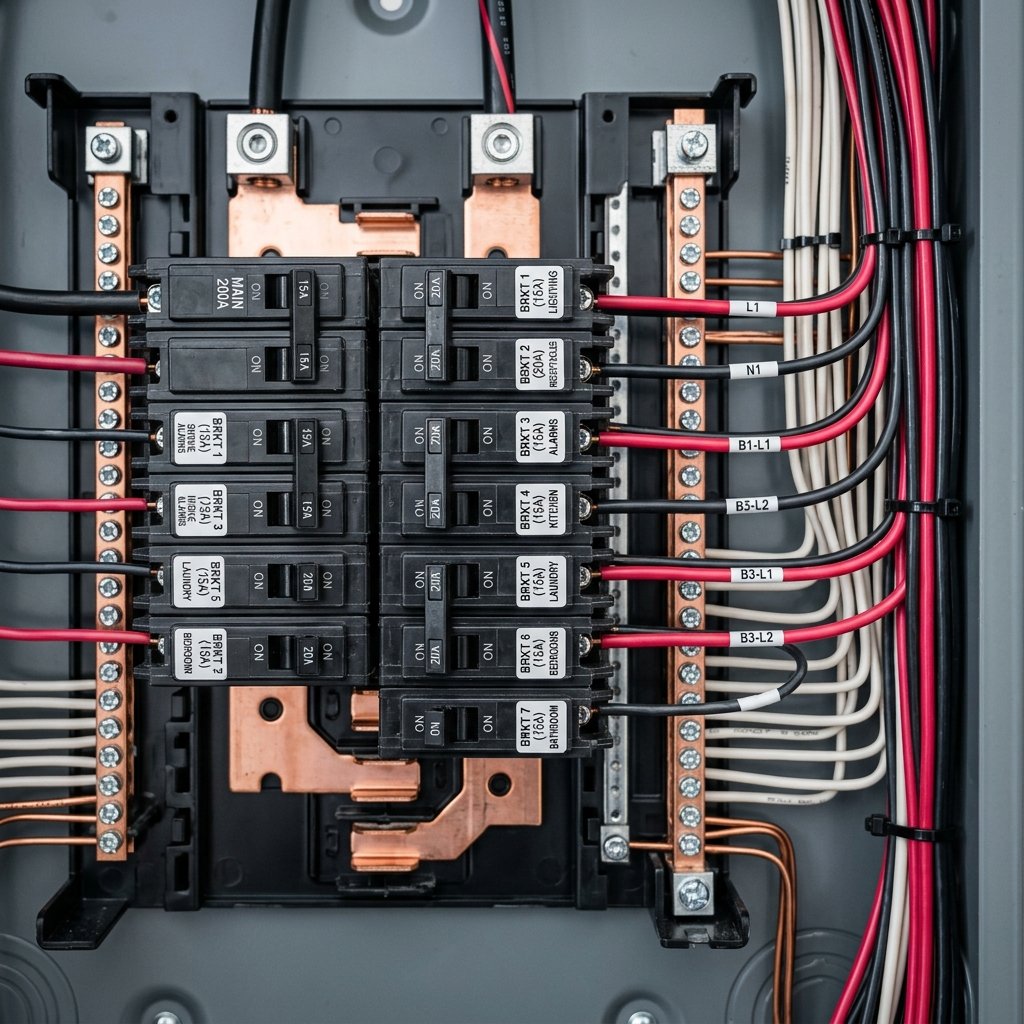
Interactive 3D Electrical Panel Explainer
Click on different components inside this stylized electrical panel to understand how electricity enters, distributes, and isolates hazardous faults in residential systems:
On a service call in a 1970s home near Lake Howard, the homeowner reported their living room breaker tripped every evening around 6:30 PM. Our diagnostic testing revealed the living room circuit had been tapped into by a previous owner to power an exterior patio freezer and a secondary refrigerator in the garage. As soon as the garage ambient temperature spiked and both compressors kicked on simultaneously, the 15A breaker tripped exactly as designed. Isolating the garage loads onto a dedicated 20A circuit resolved the issue permanently.
Why Breakers Trip More Frequently in Winter Haven & Central Florida
Properties in Polk County face distinct environmental and meteorological challenges that directly affect electrical breaker performance:
- Ambient Garage & Attic Heat (Thermal Derating): Standard circuit breakers are calibrated to operate at an ambient temperature of 104°F (40°C). When an electrical service panel is installed inside an unconditioned Florida garage or on an exterior sun-facing wall, summer temperatures routinely exceed 120°F to 135°F. This external heat pre-heats the internal bimetallic strip, lowering the effective amperage threshold and causing breakers to trip under normal electrical loads.
- Continuous Air Conditioning Strain: Central Florida summers force A/C compressor units to run almost continuously. Older air handlers and condensing units with degrading start capacitors draw massive inrush current (LRA – Locked Rotor Amps) upon startup, frequently tripping 30A or 40A double-pole breakers.
- Lightning Capital Power Surges: Central Florida experiences the highest concentration of cloud-to-ground lightning strikes in North America. Transient high-voltage spikes can degrade sensitive AFCI/GFCI electronic sensing modules, causing nuisance tripping long after the storm passes. Installing whole-home surge protection at the main panel protects these sensitive breakers.
If a tripping breaker is accompanied by a pungent, fishy, or burning plastic odor, scorch marks on outlet cover plates, sizzling/crackling sounds inside the wall, or a panel that is hot to the touch, do not reset the breaker. Shut off the main breaker if it is safe to approach, evacuate the area, and call an electrician or emergency services immediately.
What Homeowners Can Check Safely (Do's & Don'ts)
Before contacting an electrician, you can perform basic, non-invasive troubleshooting to identify whether an overloaded appliance is the cause:
- Unplug all appliances and electronics on the affected dark circuit.
- Reset the breaker once: Push it firmly to OFF until it clicks, then firmly to ON.
- Plug devices back in one by one to determine if a specific appliance triggers the trip.
- Keep note of which room outlets are affected to assist your technician.
- Do NOT repeatedly reset a breaker that trips immediately.
- Do NOT remove the metal deadfront cover of your electrical panel.
- Do NOT tape, wedge, or hold the breaker handle in the ON position.
- Do NOT use extension cords as a permanent workaround across rooms.
Breaker Keeps Tripping After Reset?
Persistent trips signal a wiring or component fault that requires professional multimeter isolation. Speak with our local Winter Haven dispatch team.
How a Licensed Electrician Diagnoses the Cause
When a licensed electrical contractor arrives to troubleshoot a tripping breaker, the diagnostic process follows systematic testing rather than guesswork:
- Visual & Thermal Inspection: We inspect the service panel bus bar for pitting, corrosion, signs of arcing, or thermal discoloration where the breaker stabs connect.
- Circuit Amperage Load Measurement: Using a calibrated digital clamp meter, we measure the real-time amperage draw under live conditions to determine if the circuit is truly overloaded or tripping below rating.
- Insulation Resistance Testing: If a short circuit or ground fault is suspected, we disconnect branch conductors and perform megohmmeter (megger) testing to detect degraded wiring insulation inside walls without destructive tearing of drywall.
- Receptacle & Junction Box Isolation: We test individual outlets, GFCI receptacles, and junction boxes sequentially to isolate the exact location of ground leaks or loose neutral terminations.
- Code-Compliant Repair Plan: Once the root failure is verified, we explain the required repair—whether it requires dedicated circuit addition, receptacle replacement, wire splice repair, or breaker replacement—before any work commences.
When Should You Call an Electrician?
- The breaker trips immediately upon reset: Indicates a dead short circuit that cannot be resolved by unplugging devices.
- The breaker handle feels loose, hot, or will not latch: Indicates internal mechanical failure or bus bar terminal arcing.
- Flickering lights occur on multiple circuits: Points to a potential failing main neutral connection or panel bus failure.
- Your panel is an older FPE Stab-Lok, Zinsco, or fuse box: Recognized fire hazards that frequently fail to trip during dead shorts.
- You need dedicated circuits for modern appliances: EV chargers, heat pumps, induction ranges, and workshops require dedicated wiring under the National Electrical Code.
Electrical Repair & Panel Services in Winter Haven
Our licensed electricians arrive equipped with specialized digital diagnostic instruments and commercial-grade replacement breakers to safely diagnose and resolve your electrical issues.
Frequently Asked Questions About Tripping Breakers
You should only reset a tripped breaker once after disconnecting high-draw appliances. If the breaker trips again immediately or within a few minutes, do not continue resetting it. Repeatedly resetting a breaker into an active short circuit or persistent overload accelerates insulation damage and can cause mechanical failure of the breaker contacts.
A slight warmth is normal during heavy continuous operation because current flow creates natural electrical resistance. However, if a breaker is uncomfortably hot to touch, smells like burnt plastic, or has visible discoloration, it indicates a loose terminal connection, internal resistance buildup, or severe overload. Have an electrician inspect it immediately.
Motorized equipment like air conditioner compressors and refrigerator motors draw a surge of startup current (Locked Rotor Amps) that is 3 to 5 times higher than their steady running current. As equipment ages or starting capacitors weaken, this startup spike exceeds the breaker's momentary tolerance, causing the breaker to trip.
Replacing a circuit breaker requires removing the metal panel deadfront, exposing live bus bars and incoming utility service lines that carry lethal voltage even when the main breaker is switched off. Breakers must also be matched to the exact panel manufacturer specifications and bus bar geometry. For your safety and code compliance, breaker replacements should always be handled by a licensed electrician.
A GFCI (Ground-Fault Circuit Interrupter) protects people from electrical shock by cutting power when current leaks to ground (such as through water). An AFCI (Arc-Fault Circuit Interrupter) protects structures from electrical fires by detecting the erratic electrical frequency of sparking and arcing behind walls or in damaged cords.

Winter Haven Electrician Editorial Team
Our educational resources are researched and produced by licensed electrical professionals serving Winter Haven, Auburndale, and surrounding Central Florida communities. All technical guidance aligns with the National Electrical Code (NEC) and the Florida Building Code to promote homeowner safety and dependable electrical practices.
Sources & Authoritative References
Technical Standards & Safety References
- NFPA 70: National Electrical Code (NEC) – Articles 210 (Branch Circuits), 240 (Overcurrent Protection), and 406 (Receptacles).
- U.S. Consumer Product Safety Commission (CPSC) – Residential Electrical Safety Guidelines & Panel Recalls.
- Electrical Safety Foundation International (ESFI) – Home Circuit Breaker Safety and Warning Sign Analysis.
- U.S. Department of Energy (DOE) – Residential Power Demand, Capacity, and Continuous Load Standards.