Generator Interlock vs. Transfer Switch: Which Is Best for Florida Homes?
An interlock kit installs directly on your existing breaker panel and energizes the whole busbar—allowing you to power whichever circuits you choose up to your generator capacity—for roughly $800–$1,500 installed. A traditional transfer switch powers only 6 to 10 pre-selected circuits via a secondary subpanel and costs $1,500–$2,500+. For Florida homeowners seeking storm backup flexibility on a budget, a generator interlock kit is almost always the superior, more adaptable solution.
- Panel flexibility: Interlocks power the entire panel busbar; you turn on the breakers you need. Transfer switches restrict you to 6–10 pre-wired circuits forever.
- Half the installation cost: Interlocks require no secondary subpanel or wire splicing, cutting labor and material costs by 40% to 60%.
- 100% code compliant: UL-listed mechanical interlock plates make it physically impossible to backfeed utility power, protecting linemen and conforming to NEC 702.6.
- Can run central AC: When paired with an AC Soft Start kit, a 9,000W–12,000W portable generator through an interlock can start and run a 3-to-4 ton heat pump.
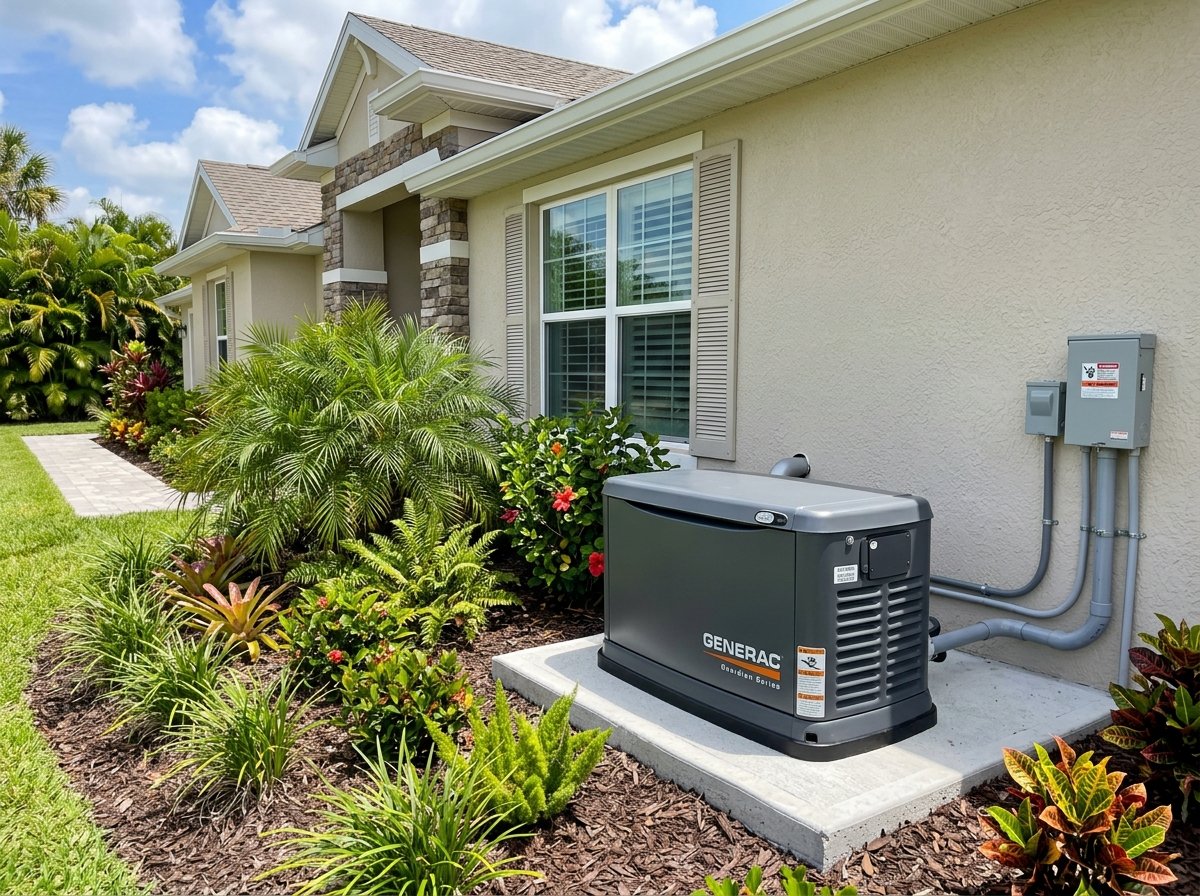
- Exterior inlet box safety: Both systems require a heavy-duty NEMA 3R exterior inlet box (30A or 50A) keeping the generator outdoors and preventing carbon monoxide poisoning.
- Quick Answer
- How Backup Power Systems Work During Florida Hurricanes
- What Is a Generator Interlock Kit?
- What Is a Traditional Manual Transfer Switch?
- Interlock vs. Transfer Switch: Direct Comparison
- Can a Portable Generator Run Central AC in Florida? (The Soft Start Secret)
- The Lethal Hazard of Illegal DIY "Backfeeding"
- Frequently Asked Questions
Need Safe, Professional Electrical Assistance?
Don't take risks with hazardous electrical panels, wiring anomalies, or storm power connections. Our licensed Florida electricians provide upfront pricing and dependable craftsmanship.
How Backup Power Systems Work During Florida Hurricanes
When a tropical storm or major hurricane knocks out power across Polk County, TECO and Duke Energy restoration can take days or even weeks. Running extension cords through windows creates trip hazards, crushes door seals, and limits power to a few lamps and a refrigerator.
Both a generator interlock kit and a manual transfer switch provide a code-compliant, permanent electrical bridge between your portable generator and your home's wiring. You plug a heavy-duty generator cord into a weather-sealed exterior inlet receptacle, start the generator, and send clean power directly through your home's existing copper wiring to ceiling fans, outlets, refrigerators, well pumps, and lights.
What Is a Generator Interlock Kit?
A mechanical generator interlock kit consists of an engineered, custom-machined steel sliding plate mounted directly over your electrical panel face. It mechanically couples the main utility breaker handle to an adjacent top-position double-pole generator backfeed breaker.
A sliding barrier that physically guarantees the main utility breaker and the generator backfeed breaker cannot be switched to ON at the same time, preventing dangerous utility backfeeding.
Because the interlock energizes the panel's main copper busbars, every single branch circuit in your home is accessible. You have the total freedom to power your refrigerator, internet router, master bedroom, well pump, or kitchen outlets—as long as your total running wattage remains within your generator's rated capacity.
What Is a Traditional Manual Transfer Switch?
A traditional manual transfer switch is a separate electrical subpanel installed immediately adjacent to your main breaker box. Inside this secondary box are 6, 8, or 10 pre-installed double-throw toggle switches, each hardwired to an individual household circuit.
During a blackout, you flip each individual switch from "LINE" to "GEN". While reliable, this system has a major drawback: whatever 6 or 8 circuits you selected during installation are the only circuits you can ever power. If you decide you want power in the home office or guest bedroom during an extended outage, you cannot power those rooms without hiring an electrician to rewire the subpanel.
Interlock vs. Transfer Switch: Direct Comparison
| Feature | Generator Interlock Kit | Manual Transfer Switch |
|---|---|---|
| Average Installed Cost | $800 – $1,500 | $1,500 – $2,500+ |
| Circuits Accessible | Entire Home (All Circuits) | Only 6 to 10 Pre-Selected |
| Panel Space Needed | 2 Breaker Spaces | Separate Subpanel Box on Wall |
| Can Run 240V Well Pump / AC | Yes (Easily Selected) | Only If Pre-Wired with Dual-Pole Switch |
| NEC Code Compliance | NEC 702.6 Compliant | NEC 702.6 Compliant |
Can a Portable Generator Run Central AC in Florida? (The Soft Start Secret)
A common myth in Central Florida is that you must buy a $15,000 whole-home standby generator to run central air conditioning during a hurricane. In reality, a standard 9,000W–12,000W portable generator paired with an interlock can start and run a 3-ton to 4-ton AC condenser when you install an AC Soft Starter.
A standard residential AC compressor requires massive "Locked Rotor Amps" (LRA)—often 60 to 90 amps for a split second—which will stall most portable generators. An advanced electronic Soft Starter ramps up compressor motor torque smoothly, reducing starting inrush current by up to 70%. Once running, the AC draws only 12 to 16 amps, well within your generator's capacity.
The Lethal Hazard of Illegal DIY "Backfeeding"
During every hurricane season, news reports document injuries or fatalities caused by homeowners attempting to connect a generator through a clothes dryer outlet using a homemade double-male cord (often called a "suicide cord").
A certified generator interlock kit completely eliminates this risk through physical mechanical lockout.