
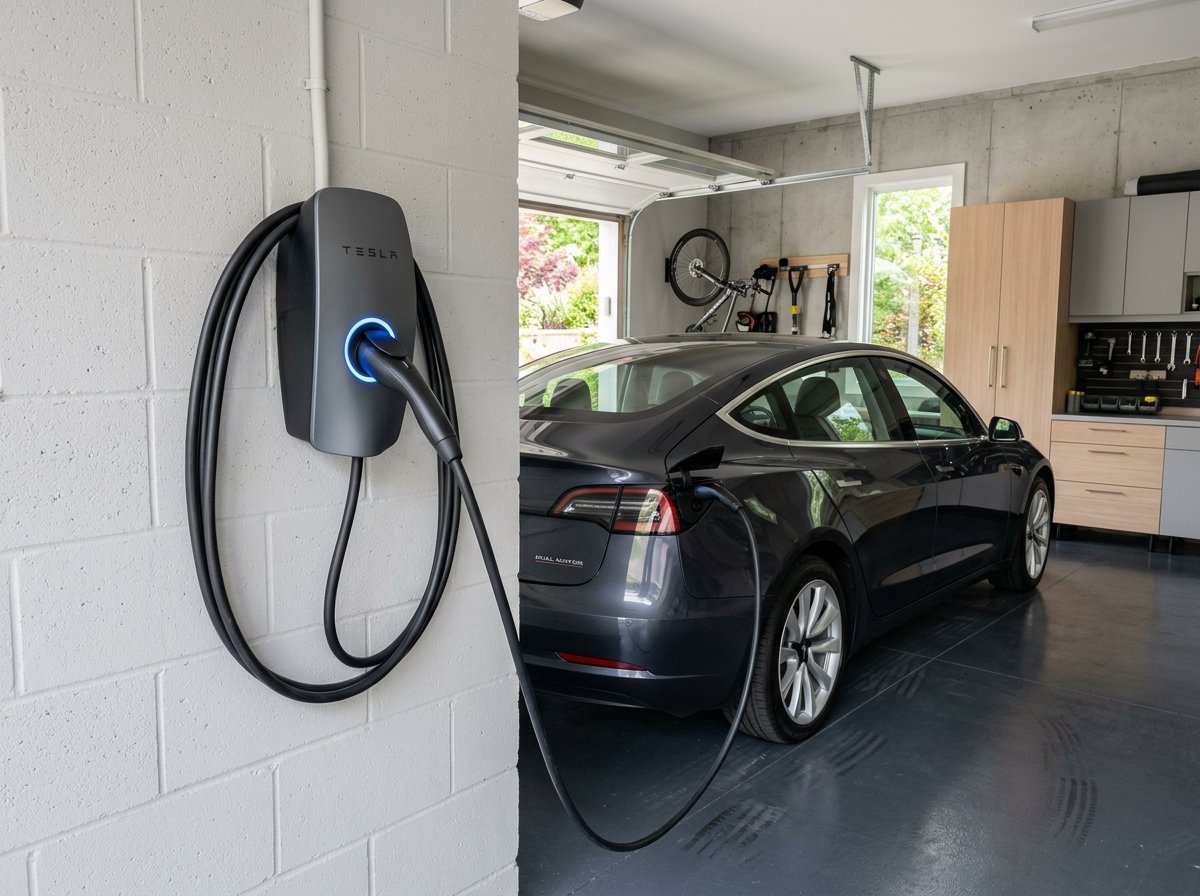
What is the Difference Between Level 1 and Level 2 EV Charging?
The fundamental difference is voltage, charging speed, and electrical requirements. A Level 1 charger uses standard 120-volt household electricity, adding only 3 to 5 miles of driving range per hour (taking 30 to 50+ hours for a full charge). A Level 2 charger runs on a dedicated 240-volt circuit (similar to an electric clothes dryer), delivering 7.2 kW to 11.5 kW of power to add 25 to 45 miles of range per hour, allowing a completely depleted battery to recharge fully overnight in 4 to 8 hours while achieving higher electrical efficiency.
- Speed difference is 6× to 10×: Level 1 adds ~4 mph; Level 2 adds 30 to 45 mph of battery range.
- Level 2 is 10–15% more energy efficient: Shorter charge windows reduce the hours the vehicle's onboard cooling pumps and computers run.
- Dedicated 240V circuit required: Level 2 requires a dedicated 40A, 50A, or 60A double-pole breaker with #6 or #4 AWG copper wire.
- Hardwired beats plug-in: Hardwired installations allow maximum 48A continuous charge rates and avoid nuisance GFCI breaker trips.
- Crucial for Central Florida commuters: Daily roundtrips between Winter Haven, Lakeland, Tampa, and Orlando require Level 2 overnight recovery.
- Quick Answer
- 1. Charging Speed & Recharge Time Comparison
- 2. Energy Efficiency & Parasitic Power Loss
- 3. Level 1 vs. Level 2 Technical Comparison Table
- 4. Electrical Panel & Circuit Requirements
- 5. Hardwired Installation vs. NEMA 14-50 Outlet
- 6. Frequently Asked Questions
- 7. Authoritative Sources & References
Charging Speed & Recharge Time Comparison
To understand the daily impact on your routine, consider how long it takes to charge popular electric vehicles from 10% to 80% state of charge:
Level 1 Charging (120V / 12A)
• Range Added per Hour: 3 to 5 miles
• 60 kWh Battery (Tesla Model 3, Chevy Bolt): 32 to 38 hours
• 80 kWh Battery (Ford Mustang Mach-E, Hyundai Ioniq 5): 42 to 50 hours
• 130 kWh Battery (Ford F-150 Lightning, Rivian R1T): 70+ hours (nearly 3 days!)
Level 2 Charging (240V / 48A Hardwired)
• Range Added per Hour: 30 to 45 miles
• 60 kWh Battery (Tesla Model 3, Chevy Bolt): 4 to 5 hours
• 80 kWh Battery (Ford Mustang Mach-E, Hyundai Ioniq 5): 6 to 7 hours
• 130 kWh Battery (Ford F-150 Lightning, Rivian R1T): 9 to 11 hours (overnight full charge)
Energy Efficiency & Parasitic Power Loss
One crucial factor most EV buyers overlook is charging efficiency. Converting alternating current (AC) from your wall into direct current (DC) inside your vehicle’s battery pack incurs energy conversion losses.
When an EV is charging, its battery thermal management system, onboard computer, and AC-DC inverter remain continuously powered:
- Level 1 Efficiency (~72% – 78%): Because the vehicle must remain awake for 35 to 45 hours, the onboard cooling pumps and computers consume approximately 200 to 300 watts of parasitic power the entire time. Nearly a quarter of the electricity you pay for is wasted as thermal overhead.
- Level 2 Efficiency (~88% – 92%): Because Level 2 finishes charging in 4 to 6 hours, the vehicle’s support systems run for a fraction of the time, resulting in substantially lower utility waste over the lifespan of the vehicle.
Summer Garage Temperatures: In Central Florida garages during July and August, temperatures frequently exceed 100°F. When Level 1 charging takes 36 hours in extreme heat, the vehicle's battery cooling fan runs non-stop, further reducing charging speed and degrading efficiency. Level 2 completes charging before peak morning heat arrives.
Level 1 vs. Level 2 Technical Comparison Table
| Specification / Feature | Level 1 EV Charger | Level 2 EV Charger |
|---|---|---|
| Operating Voltage | 120 Volts AC (Standard Household) | 240 Volts AC (Dedicated Branch) |
| Amperage Draw | 12 Amps continuous (on 15A circuit) | 32A to 48A continuous (40A to 60A breaker) |
| Power Output (kW) | 1.4 kW to 1.9 kW | 7.2 kW to 11.5 kW |
| Miles Added Per Hour | 3 to 5 miles/hour | 25 to 45 miles/hour |
| Typical Overnight Range (8 hrs) | 25 to 35 miles total | 200 to 300+ miles total (Full Battery) |
| Electrical Circuit Type | Shared or dedicated 120V outlet | Dedicated 240V circuit with double-pole breaker |
| Conductor Wire Size | 14 AWG or 12 AWG copper | #6 AWG or #4 AWG copper wire |
| Charging Efficiency | ~72% – 78% (high parasitic loss) | ~88% – 92% (highly efficient) |
| Utility Off-Peak Compatibility | Poor (charging spans multiple rate periods) | Excellent (finishes inside super-off-peak window) |
Electrical Panel & Circuit Requirements
This means:
- A 32-amp charger requires a 40-amp circuit breaker.
- A 40-amp charger requires a 50-amp circuit breaker.
- A 48-amp charger (Tesla Wall Connector maximum rate) requires a 60-amp circuit breaker.
Before installing a Level 2 charging station, a licensed electrical contractor must evaluate your home's total electrical service. If your home operates on an older 100-amp panel, adding a 50A or 60A continuous load may exceed your calculated demand, requiring a 200-amp electrical panel upgrade. Check our guide on how to know if your panel can handle an EV charger.
Hardwired Installation vs. NEMA 14-50 Outlet
When installing a Level 2 charger, you have two configuration options:
Option A: Hardwired Connection (Recommended)
The electrical conduit runs directly into the charging station without a plug. Hardwired setups provide significant advantages:
- Faster Charging: Supports up to 48A continuous charging on a 60A breaker (11.5 kW output).
- No Nuisance GFCI Tripping: Under NEC 2020/2023, 240V garage receptacles require GFCI breakers. Most EV chargers also have internal GFCI circuitry. When two GFCI systems monitor the same line, they frequently conflict, causing nuisance trips. Hardwiring eliminates this issue.
- Superior Weatherproofing: Eliminates exterior receptacle gaskets that can degrade in Florida moisture.
Option B: NEMA 14-50 240V Outlet
The electrician installs a heavy-duty 50-amp commercial receptacle (such as an industrial-grade Bryant or Hubbell 14-50 outlet) into which you plug a mobile connector. Maximum charge rate is capped at 40A continuous (9.6 kW).
Frequently Asked Questions: Level 1 vs. Level 2 EV Chargers
No. Level 1 charging does not harm the battery cells because the charge rate is very low. However, it is energy-inefficient because the vehicle's thermal cooling systems and computers run for 30 to 45 hours, wasting more electricity than Level 2 charging.
No. EV manufacturers and the National Electrical Code strongly warn against using standard household extension cords for EV charging. Pulling 12A continuous across an undersized cord causes high electrical resistance, melting plugs and creating an immediate fire hazard.
Professional installation of a dedicated 240V Level 2 EV charging circuit in Polk County typically costs $650 to $1,400 for labor, permitting, and wiring materials when the electrical panel has available capacity and is located near the garage.
Yes. Universal Level 2 chargers use the industry-standard J1772 connector, which charges all non-Tesla EVs (and Teslas using the included adapter). Tesla Wall Connectors now feature the NACS standard or Universal J1772 docks, charging any electric car on the market.
Authoritative Sources & Further Reading
- National Electrical Code (NEC): Article 625 (Electric Vehicle Power Transfer Systems).
- U.S. Department of Energy (DOE) - Alternative Fuels Data Center: Developing Infrastructure to Charge Plug-In Electric Vehicles.
- Society of Automotive Engineers (SAE): SAE J1772 Electric Vehicle and Plug in Hybrid Electric Vehicle Conductive Charge Coupler.
- Idaho National Laboratory: Plug-In Electric Vehicle Charging Infrastructure Efficiency Study.